


Case Study
14th April 2025
Sunderland City Council is continuously exploring opportunities to improve the safety of residents, while driving efficiencies in service delivery.
Flooding remains a significant concern for Sunderland City Council, particularly in areas prone to water buildup. To address this, Sunderland is piloting smart trash screens and gullys to modernise maintenance services, improve efficiency, and proactively mitigate flood risks. The pilot aims to reduce the risk of flooding through early warnings while enhancing understanding of cleaning cycles for trash screens and gullys.
Currently, the council’s approach to managing trash screens and gullys relies on manual inspections. These inspections, conducted monthly for critical locations and quarterly for others, are both time-consuming and labour-intensive, particularly for remote sites. This process means that blockages, which could lead to flooding, may not be identified until an inspection occurs.
Recognising the need for a proactive and efficient approach to flood risk management, Sunderland City Council’s Smart City team partnered with the Highways Design and Infrastructure Management Flooding and Coastal team to pilot advanced sensor technology. The primary goal was to improve monitoring of trash screens and gullys, alongside reducing the reliance on manual inspections.
In October 2024, the council installed trial sensors, initiating a test phase that eagerly awaited rain to evaluate the sensor’s performance. Following adjustments to the dashboard based on early feedback, the pilot successfully demonstrated the potential of smart sensors to monitor trash screens and gullys.
Two sensors were deployed: one at a trash screen located near Backhouse Park and another at a frequently flooded gully in Houghton-le-Spring. These locations were chosen to gather insights into their specific challenges. The sensors are designed to monitor water levels in real-time: for the selected trash screen, sensors measure water height on both sides to determine if cleaning is required, and the chosen gully has been fitted with a sensor to track water levels and silt buildup.
Due to the underground placement of many gullys and trash screens, the sensors use 4G connectivity rather than our city’s LoRaWAN network, ensuring reliable communication in more difficult to reach locations. Our network of networks across Sunderland have been developed thanks to the council’s unique 20-year joint venture partnership with Boldyn Networks.
A user-friendly dashboard integrates rainfall data and water level readings, triggering alerts when thresholds are crossed (water levels exceeding 1 metre). This enables immediate action from the council and provides a comprehensive view of overall system performance. The system’s ability to differentiate between blockages and natural water level changes further enhances its utility.
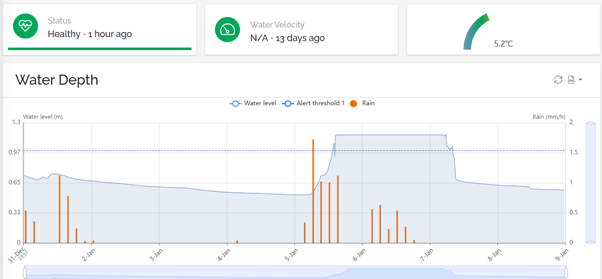
Dashboard demonstrating water depth and velocity
By leveraging IoT sensor technology, the council aims to free up time for colleagues, improve record-keeping, and ensure timely responses to potential flood risks. By providing early warnings for potential floods and delivering real-time data, the pilot has laid the groundwork for significant improvements in flood management and service efficiency.
The installation of smart sensors for monitoring trash screens and gullys has demonstrated significant potential to reduce flood risks through early warnings and improved cleaning cycles. By providing real-time data on water levels, the sensors have enabled the council to ensure that blockages are addressed promptly, reducing the risk of flooding and its associated damages.
This technology has also reduced the need for frequent manual inspections, freeing up valuable time and resources for the council. Additionally, the integration of rainfall data into the dashboard has further enhanced decision-making. This allows colleagues to differentiate between natural water level increases and blockages, encouraging targeted interventions, and focusing council resources where they are most needed.
Sunderland City Council is not only improving operational efficiency but also protecting residents, homes, and infrastructure from the effects of flooding, and reducing the potential financial burden of flood damage. With plans to deploy nine additional sensors across the city, this pilot demonstrates how smart city innovation not only encourages operational efficiency, but also leads to safer and more resilient communities.
The Sunderland Smart City programme is committed to ensuring that no one and nowhere is left behind. To learn more about our range of projects and pilots, visit our Innovation Challenges page.